
AI SEO and Generative Engine Optimisation (GEO) help B2B brands get their solutions recommended by ChatGPT, Perplexity and Gemini AI – as well as Google AI Overviews. Marketers can win more prospects from organic content and reduce ad spend. Read on to discover more.
What’s changing in the way B2B prospects search?
Do you still search using a few keywords in Google – or do you ask conversational questions within ChatGPT and get AI answer summaries in one click? Search is changing fast and more people are relying on AI overviews and recommendations.
Results appear in three ways:
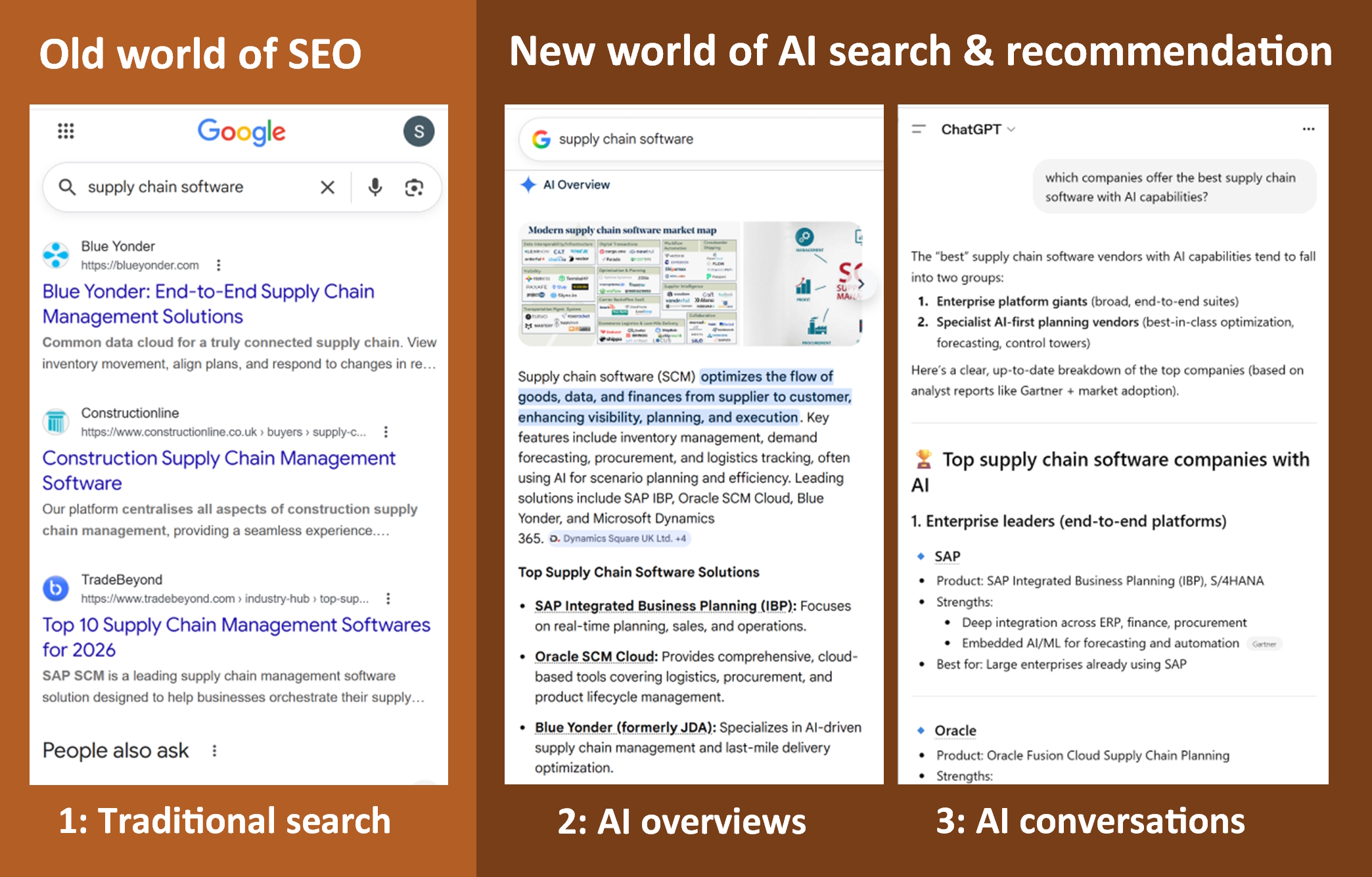
1. Traditional search: Google gives search results in the normal way
2. AI overviews: AI engines, such as Google’s Gemini, provide answers in summaries
3. AI conversations: ChatGPT surfaces its own research for you
B2B tech brands need to raise their profile in categories (2) and (3). That’s where AI SEO and GEO make the difference. It’s also where B2B customers are increasingly finding answers because it’s fast and convenient. AI engines do the searching and sifting – and then deliver curated answers.
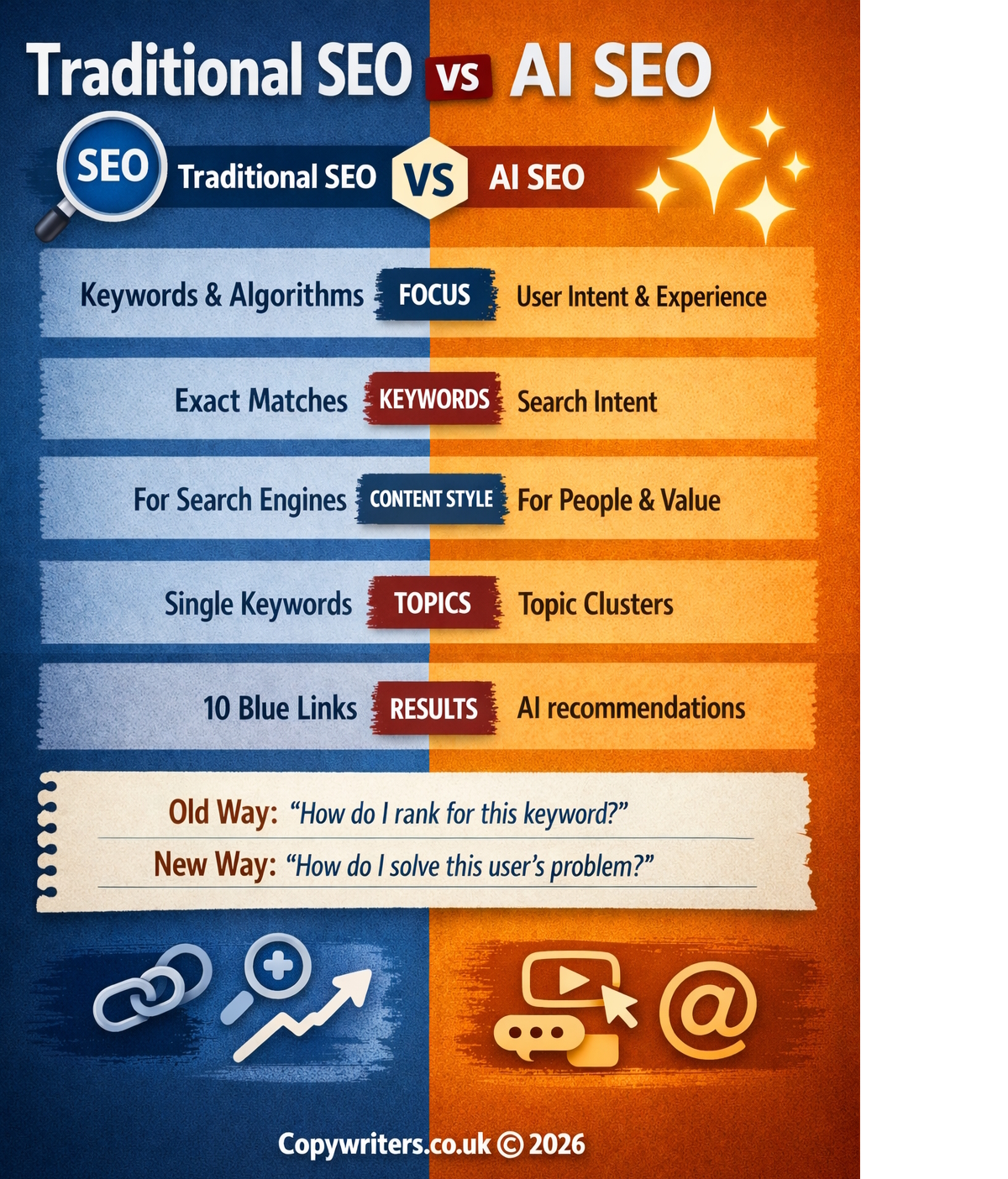
Let’s explore this topic in more detail.
Explore AI seach, SEO and Generative Engine Optimisation (GEO)
Frequently Asked Questions
Do I need AI SEO and Generative Engine Optimisation (GEO)?
Yes. AI SEO and Generative Engine Optimisation (GEO) are now essential for visibility in modern search. Internet search is changing rapidly, with users increasingly relying on AI-generated overviews for direct answers. AI platforms like ChatGPT, Gemini and Perplexity also recommend brands within conversational responses, making AI visibility critical.
Is traditional SEO still relevant in the age of AI search?
Is traditional SEO still relevant in the age of AI search? Yes. Traditional SEO remains the foundation of search visibility. Web pages still require keyphrases and meta descriptions, with search terms appearing in the right places. However, AI-focused SEO and GEO position your brand as the authoritative answer that AI engines select and cite through structured, high-value content.
What’s the difference between AI SEO, GEO and AEO?
What’s the difference between AI SEO, GEO and AEO? AI SEO, GEO and AEO are closely related but serve different roles. AI SEO focuses on creating high-quality, authoritative content likely to be cited by AI. GEO (Generative Engine Optimisation) structures content for easy retrieval and reuse by AI systems. AEO (Answer Engine Optimisation) focuses on concise, direct answers to specific questions.
What does ‘zero click’ search mean?
Zero-click search is when users receive a complete answer directly from an AI-generated summary without clicking on a website. It offers speed, convenience and depth of research. Studies suggest users are increasingly satisfied with a single summary, rather than searching further.
How many B2B tech brands are deploying AI SEO and GEO?
AI SEO and GEO adoption in B2B is still in its early stages. There is limited published data, but many B2B tech marketers have yet to implement these approaches. This creates a significant early-mover advantage for brands that adopt AI SEO and GEO, enabling higher content ROI and reduced acquisition costs.
What kind of content should be optimised for AI SEO and GEO?
AI models prioritise content that demonstrates clear topical authority. Prioritise product and service pages, as these establish expertise in core topics. You should also optimise About pages, FAQs, blogs and thought leadership content to strengthen authority signals and increase the likelihood of being cited.
How can we get mentioned by ChatGPT, Gemini and Perplexity?
AI platforms cite content that is easy to extract as a complete, direct answer. This means content must be structured, specific and clearly written. Strong brand authority increases your chances of being cited, but without a clear AI SEO and GEO strategy, more agile competitors may be recommended instead.
Should we divert our search ads spend to AI SEO and GEO?
AI SEO and GEO performance should be measured against paid search using direct ROI comparison. The most effective approach is to test both alongside each other and evaluate results. Test pages using AI SEO and GEO can deliver measurable insights within 2–4 weeks, helping assess performance before reallocating budget.
How can I optimise my content for AI search engines and GEO?
Optimising for AI requires high factual density, expert insight and clearly structured answers. AI models prioritise precise language, clear answers and unique insights they can cite verbatim. Content should include original data, strong viewpoints and easily extractable statements.
Will AI SEO and GEO mean we have to replace our existing SEO and web content?
AI SEO and GEO typically require updating and enhancing existing content rather than replacing it. Most SEO content can be retained but should be refined to improve authority, depth and alignment with how AI models evaluate and select sources. That’s where skilled copywriting counts.
Should we use an SEO agency for AI search and GEO?
AI engines prioritise original insight over generic AI-generated content. Be cautious when selecting an SEO agency for AI SEO and GEO, as reliance on generic content can reduce visibility. Your content should demonstrate genuine expertise and authority to be cited. That’s where an AI-savvy copywriter can give you the edge.
Should we use a copywriter for AI search and GEO?
Effective AI SEO and GEO require structured, insight-led writing rather than keyword optimisation alone. A skilled copywriter can improve visibility in AI search, but they must understand how AI models evaluate content and prioritise clarity, authority and audience relevance.
How can I measure the success of our AI search and GEO strategy?
You can measure success in multiple ways. Use incognito mode in Google and test if your brand is being cited in AI overviews. Check within ChatGPT and other AI engines if you’re being cited in conversations. Examine any increases in web traffic and see if referrals are coming from AI engines, often appearing as direct traffic.
What’s the best way to start implementing an AI SEO and GEO strategy?
The best approach is to start small, check results as you go and build confidence before scaling. Think tactically and prioritise web pages for products and services that are core to your business and USP, while also considering FAQs, About pages and new solution areas.
Ready to get started?
Check out our AI SEO and GEO strategy page for how we can help you. Contact us and we’ll recommend a test page to optimise for AI SEO and GEO, so you can start seeing the benefits.
Discover more on this topic
Why an AI-savvy copywriter can save you from AI SEO/GEO disasters
B2B case study: How do we optimise for AI search and GEO not just Google rankings?
Credit: Main photo by Vitaly Gariev on Unsplash