
If you could spend hours with two top marketing gurus, what would you ask them? A couple of legends gave us their gems a few years ago — and here’s a glimpse.
You know that feeling when you see something so horrendously stooopid in marketing: Maybe it’s on social media, in a TV advert or at a product launch?
You’re wondering what on earth the brand is doing? Has its marketing team and creative agency lost the plot? Worse still, what if it’s happening at your company — and no-one else can hear you scream?
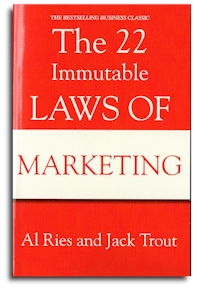
You’ll be wishing those around you had read The 22 Immutable Laws of Marketing by Al Ries and Jack Trout.
This book is dedicated by the authors to “the elimination of myths and misconceptions from the marketing process.”
Ries and Trout spent over 25 years studying why some marketing ideas succeed while others crash and burn.
They hit upon fundamental rules — marketing’s equivalent to the forces of nature.
I won’t steal the book’s thunder and list all 22 Laws. But here’s a glimpse at three of them.
The Law of Focus: This is really useful if you’re working on branding for your company or a product. It reveals the importance of owning a single word in the minds of prospects (eg. Volvo = ‘safety’ and Heinz =’ketchup’). The book gives wise advice on how it’s done — and leaves you thinking: What single word should we try to own?
The Law of the Ladder: This is genius. Basically, your next marketing move should depend on the rung you currently occupy on the marketplace ladder (compared to competitors). Don’t claim to be the best when you’re well down the pecking order. Use a different way to get into the minds of prospects.
The book cites the brilliant strapline adopted by aspiring car-hire firm Avis:
‘So why go with us? We try harder.’
It was a huge success. But the company later changed it to: ‘Avis is going to be No.1’. Consumers didn’t like it and that campaign flopped.
The Law of Acceleration: What happens when your products start taking off (in the B2C world especially)? The book defines the critical difference between a fad (like the Ninja Turtles) and a trend (like Barbie). Fads rise fast and then disappear, with companies going into a deep financial shock.
What you really want is a trend, a slow-burner. If things start taking off, don’t fan the flames. Instead, dampen things down — and never totally satisfy demand.
Ries and Trout apply the rule widely …
“The most successful entertainers are the ones who control their appearances. They don’t overextend themselves. They’re not all over the place. They don’t wear out their welcome. Elvis Presley’s manager, Colonel Parker, made a deliberate attempt to restrict the number of appearances and records the King made. As a result, every time Elvis appeared, it was an event of enormous impact.”
The book is packed with great advice.
If you’re a challenger in your marketplace and wondering how to cut through, then read ‘The Law of the Opposite’.
If you’re thinking of taking your brand into new areas, then you must see ‘The Law of Line Extension’.
If there’s a downside to your product or service, don’t worry. You may uncover a great marketing angle if you check out ‘The Law of Candor’.
But following these laws may cause problems for you within your organisation because they challenge common misconceptions. A lot of people won’t like what you say.
The book comes with a warning from the authors …
“If you apply the immutable laws, you run the risk of being bad-mouthed, ignored or even ostracised. Have patience. The immutable laws of marketing will help you achieve success. And success if the best revenge of all.”
Although the book came out in 1993 and some stories feel dated, the principles remain true. It’s packed with fascinating tales of marketing tussles from corporate America.
My thanks goes to my friend Mike Faith, CEO of Headsets.com, for giving me this book 10 years ago.